
 Staff dispatch
 Staff transport
 School transport
 Freight transport
 Construction & civil works
 Mines & quarries
 Agriculture
 Product distribution
 Cold-chain distribution
 Waste collection
 Ambulances & healthcare
 Vehicle rental
 Taxis
 Hotels & restaurants
Morocco is building modern logistics. So why do some companies still work the way they did 20 years ago?
High-performing ports, digital platforms, vehicle tracking, artificial intelligence… Morocco is moving forward with its logistics transformation. Yet in some SMEs, a phone call, a notebook and an Excel file remain the main management tools. How can this contrast be explained?
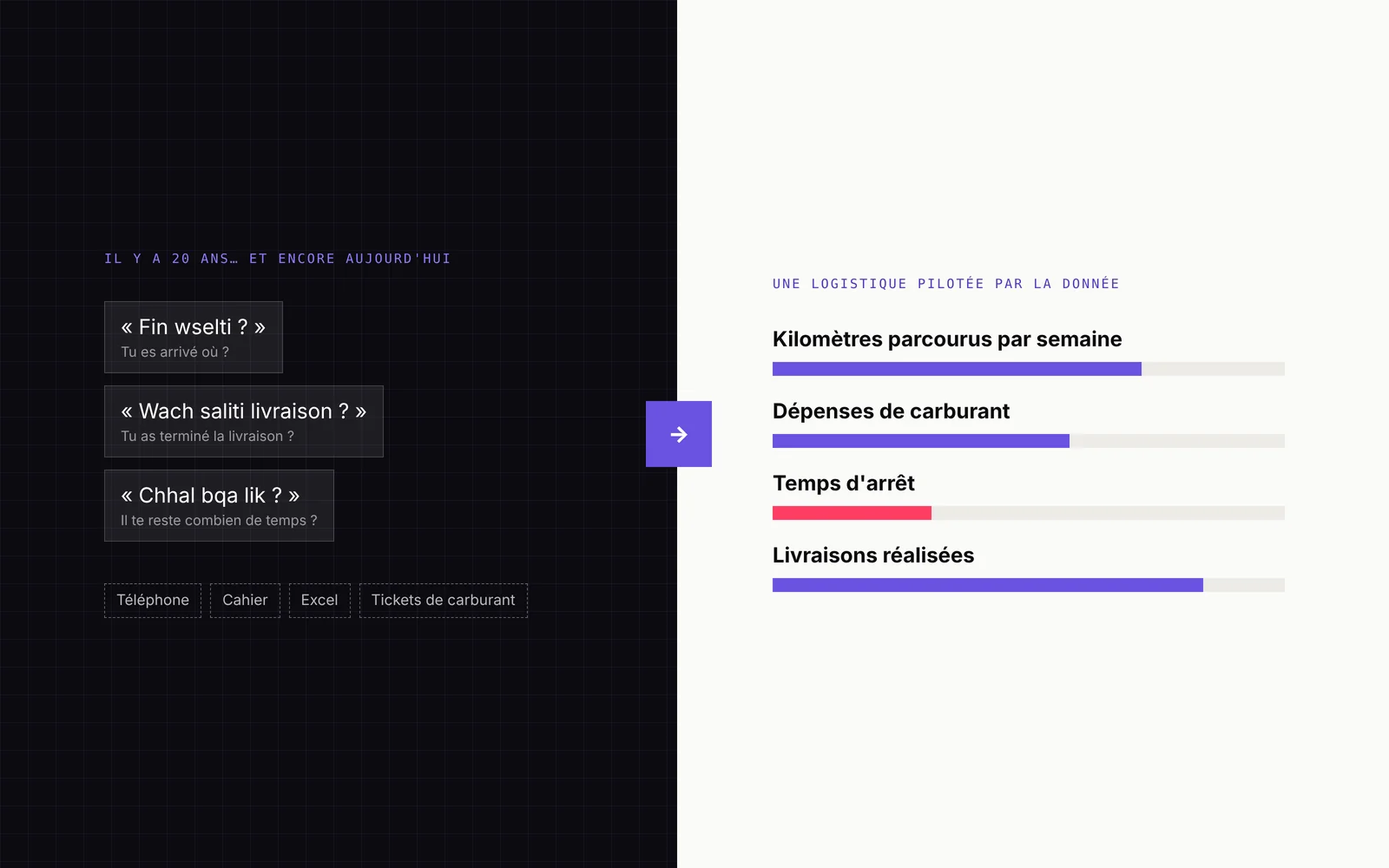
A truck, a phone and a lot of patience
Picture a transport company based in Casablanca.
It has fifteen trucks.
Every morning, the logistics manager starts his day by calling the drivers.
« Fin wselti ? » — Where are you now?
« Wach saliti livraison ? » — Have you finished the delivery?
« Chhal bqa lik ? » — How much longer will you be?
To know how deliveries are progressing, he depends on everyone's answers.
For fuel expenses, he collects receipts and invoices.
To find out whether a truck has worked, he checks a notebook or an Excel sheet.
And to confirm a delivery, he sometimes waits for a driver to send him a photo of the delivery note on WhatsApp.
This company is not imaginary in the way it works: this mix of phone, paper and simple digital tools illustrates a situation that can be found in SMEs.
But the most interesting point lies elsewhere.
The problem isn't that these companies reject technology. It's that they haven't always managed to integrate it into the way they work.
Yet Morocco has made great progress
It would be unfair to say that Moroccan logistics hasn't gone digital.
The country has modern port infrastructure and platforms designed to simplify commercial operations.
PortNet, the single window for foreign trade, illustrates the efforts to dematerialise procedures and share information between the various players.
The government is also encouraging companies to modernise.
The PME Supply Chain 2025–2029 programme, launched by Maroc PME and the Moroccan Logistics Development Agency (AMDL), notably provides support for the digital transformation of transport and logistics companies.
Its announced budget is 100 million dirhams for the period.
These are important signals.
Morocco is not discovering digitalisation.
It is now seeking to extend it and make it useful to as many companies as possible.
But there are two logistics realities in Morocco
On one side, structured companies.
They have management software, tracking systems, procedures and sometimes teams dedicated to data analysis.
On the other, SMEs that still manage a large part of their operations manually.
This contrast doesn't mean that all large companies are advanced or that all small companies are lagging behind.
But the difference in resources, skills and organisation remains real.
An academic study published in February 2026 on the digitalisation of the supply chain in Morocco confirms progress in digital adoption, but also persistent maturity gaps between large companies and SMEs.
This means one essential thing.
Digitalisation is progressing in Morocco, but not at the same pace in every company.
The real problem isn't always the budget
When digitalisation comes up, some managers immediately imagine an expensive project.
- Consultants.
- Servers.
- Complex software.
- Endless training sessions.
And perhaps several months before seeing any result.
But digitalising a business can start much more simply.
For a company with ten trucks, the first goal could be to know the kilometres driven each week.
Then to compare fuel expenses.
Next, to measure downtime.
And finally to match this information with the deliveries made.
This isn't necessarily a technological revolution.
It is above all a revolution in organisation.
Going digital doesn't mean buying the most expensive software. It means no longer losing time and money because of poorly organised information.
We have digitalised documents. Not always decisions.
This may be the most interesting paradox.
A company uses WhatsApp, Excel, invoicing software and a GPS app.
So it is equipped with digital tools.
But is it really driven by data?
Not necessarily.
If information remains scattered, the manager keeps working mainly on gut feeling.
He knows his trucks are on the road.
But does he know which ones are the most efficient?
He knows how much he spent on fuel.
But does he know why spending is going up?
He knows his revenue.
But does he know which vehicles or missions cost him the most?
Digitalisation doesn't stop at getting rid of paper.
A company can use five different software tools and keep making decisions exactly as before.
GPS: a first gateway to smart logistics
In transport, vehicle tracking is often a concrete step towards digitalisation.
A GPS system can centralise positions, trips and some operating information about the vehicles.
Depending on the equipment used, it can also help with fuel monitoring, temperature monitoring or handling certain events.
But installing GPS in every vehicle doesn't mean the transformation is complete.
It is rather the beginning.
The real question becomes:
“What do we do with the data we collect?”
Take a company with twenty trucks.
It may notice that several vehicles regularly drive extra kilometres.
This information is interesting.
But it becomes truly useful when the manager tries to understand the causes, changes the organisation and then measures the result.
A GPS collects information. Good management turns this information into action.
The Moroccan challenge is also human
In some companies, digitalisation raises concerns.
A manager used to working with a notebook may be afraid of not mastering the new software.
A driver may see the GPS as a surveillance tool.
A business owner may worry about paying a subscription for a system nobody will use properly.
These concerns are legitimate.
You don't transform a company simply by installing an app.
You need to explain, train and support.
And above all, choose tools that suit the people using them.
In Morocco, this question is particularly important.
Logistics professionals don't all use the same language.
Some are comfortable in French.
Others prefer Arabic or Darija.
A good system must take this reality into account.
Technology only becomes truly useful when the people who need it can use it easily.
Artificial intelligence could change the way we work
Picture a logistics manager who doesn't need to know every feature of his software.
He opens his phone and asks a question:
“Which trucks drove the most kilometres this week?”
He gets a clear answer.
Then he asks:
“Which ones stay stopped the longest?”
The system analyses the available data and presents the results.
Even a manager not used to charts could access the essential information.
This is one of the benefits of conversational artificial intelligence.
It can make systems more accessible.
But caution is needed.
An AI doesn't invent missing data.
It doesn't automatically know maintenance costs, salaries or the revenue of each mission.
It must work on reliable information and allow its answers to be checked.
So AI is not a magic solution.
It is a new way of making the most of existing digital systems.
The next challenge: making technology accessible to all
Morocco has major projects, technological skills and innovative companies.
But the logistics transformation can only be complete if small businesses can benefit from it too.
- A company with five trucks should be able to improve its management.
- A regional carrier should be able to track its costs.
- A school transport manager should be able to organise routes.
- A construction operator should be able to better understand how its machines are used.
Not all these companies need to adopt the same technologies.
But they must be able to access tools suited to their needs and their means.
At Mastery, this is the vision we stand for: making vehicle tracking, telemetry and data analysis technologies accessible to Moroccan companies.
With an additional ambition: making this data easier to understand through artificial intelligence and conversational interfaces.
Morocco doesn't just need more software
It needs companies that actually use the information they have.
- Managers who make decisions based on figures.
- Employees trained on simple tools.
- Systems that can talk to each other.
- And solutions that address problems on the ground rather than multiplying useless features.
Because digitalisation isn't a competition to see which company has the most apps.
It is a transformation of the way we work.
Real progress won't come on the day every Moroccan truck has a GPS.
It will come on the day companies know how to use their data to work better, reduce their losses and make better decisions.
And this transformation won't only be built in the big ports, the large companies or the technology hubs.
It will also be built in SME offices, depots, construction sites and transport companies in every region of the Kingdom.
Mastery — For smarter, more accessible and better-performing logistics in Morocco.
Sources: Maroc PME and AMDL, PME Supply Chain 2025–2029 programme; PortNet; Ghoubach and El Amine, “La digitalisation de la gestion de la chaîne d'approvisionnement et logistique au Maroc : état des lieux”, February 2026.