
 Staff dispatch
 Staff transport
 School transport
 Freight transport
 Construction & civil works
 Mines & quarries
 Agriculture
 Product distribution
 Cold-chain distribution
 Waste collection
 Ambulances & healthcare
 Vehicle rental
 Taxis
 Hotels & restaurants
Why are SME owners so lazy when it comes to analysing their GPS data?
They invest in GPS systems, monitor their vehicles and receive dozens of reports. Yet many never take the time to understand what their data could teach them.
It all starts with a rather strange situation…
Picture a business owner with 20 vehicles.
Every month, he pays for his GPS subscription. He can see where his trucks are, review their trips, monitor their speed and access detailed histories.
One day, he notices that his fuel expenses have risen sharply.
He calls his logistics manager.
“Why are we using so much diesel this month?”
The manager replies: “I'll check.”
Yet part of the answer may already be sitting in his GPS system.
But nobody has taken the time to look.
Today we have companies that own a lot of data but keep making decisions based on impressions.
Why?
1. Because an SME owner doesn't have time to analyse everything
Running an SME is not a quiet job.
You have to deal with customers, suppliers, employees, payments, the unexpected and sometimes even the drivers' personal problems.
At the end of the day, who still feels like opening a dashboard full of charts?
Even with the best intentions, analysis often takes a back seat.
The owner glances at the map, checks that his vehicles are moving and closes the app.
For him, the GPS has done its job.
But in reality, he has used only a small part of its potential.
Knowing where a truck is is not the same as knowing whether that truck is profitable.
2. Because reading a map doesn't mean knowing how to analyse data
Let's be realistic.
Anyone can understand a dot moving across a map.
But interpreting a fuel consumption chart, comparing several trips or spotting an anomaly among thousands of GPS positions takes more effort.
Let's take an example.
A truck covers 180 kilometres today, compared with its usual 140.
Is that normal?
Maybe.
You have to look at the route, the stops, the deliveries, the detours and sometimes the traffic conditions.
Looking at a number is not enough.
You have to understand it.
And this kind of analysis is not necessarily an SME owner's job.
A great entrepreneur is not necessarily a great data analyst.
He knows how to sell, negotiate, organise and take risks. That doesn't mean he has to master statistics or complex IT tools.
3. Because, yes, there is also a kind of laziness
It has to be said.
Sometimes the problem is neither time nor skills.
It's simply habit.
A manager has been using his GPS the same way for five years. He looks at the vehicles, checks a few trips and moves on.
Why change?
Why learn to use new features?
Why look at reports if the business is already running?
It's a form of intellectual laziness, or more precisely a resistance to effort.
Not necessarily because the manager is lazy in his work.
But because our brains often prefer familiar methods to new ways of thinking.
We sometimes prefer to lose a little money every day rather than spend an hour understanding why we are losing it.
And that is probably one of the most expensive paradoxes in running a business.
4. Because GPS software sometimes demands too much effort
What if the problem also came from the tools?
For a long time, GPS platforms evolved by adding ever more features.
Tables, filters, charts, alerts, reports and dozens of indicators.
All of this can be very useful.
But for a user who simply wants to know why his vehicles use too much fuel, this richness sometimes becomes an obstacle.
Imagine having to open four screens to answer a single question.
It's not necessarily the user who is lazy.
Perhaps it's the software that makes him work too hard to get a simple answer.
Technology should make life easier for businesses, not give them extra work.
5. Because invisible problems never seem urgent
- A broken-down truck is urgent.
- A customer waiting for a delivery is urgent.
- A driver who doesn't answer the phone is urgent.
But a vehicle that regularly drives a few unnecessary kilometres?
An engine left running during long stops?
A poorly optimised route?
These problems are less visible.
They don't necessarily trigger a crisis.
Yet when they repeat across several vehicles for months, their consequences can become significant.
That is where the real danger lies.
The hardest losses to control are not always the most spectacular. They are often the ones we end up getting used to.
What if we stopped asking business owners to analyse data?
This may be the most interesting question.
For years, we have been asking fleet managers to learn how to use software.
But why not reverse this logic?
Why not build software that can understand fleet managers' questions?
Picture a business owner who opens his phone and asks:
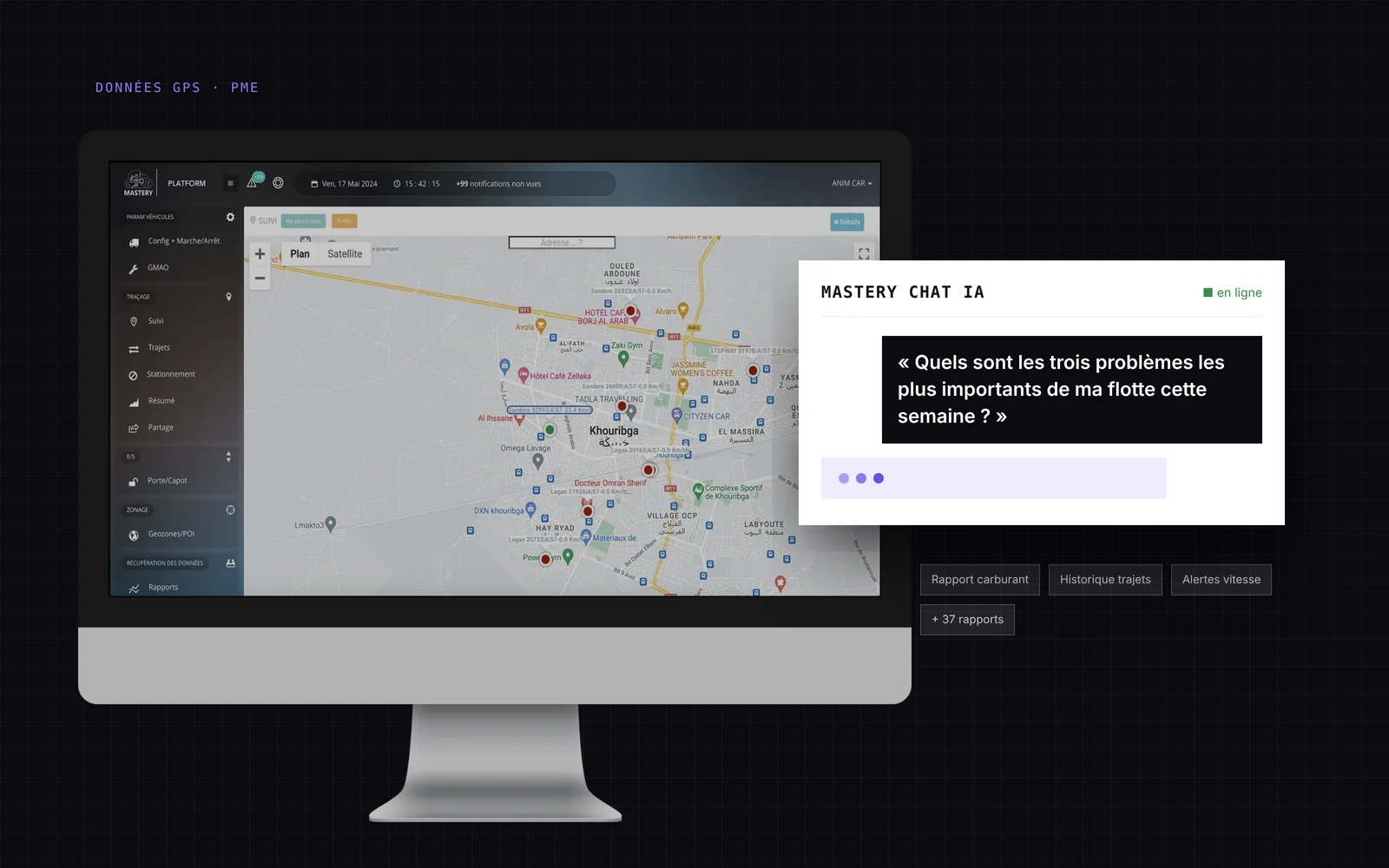
“What are the three biggest problems in my fleet this week?”
Or:
“Which truck drove the most unnecessary kilometres?”
Or even, in Darija:
« Chno homa les camions li 3andhom chi problème had simana ? »
Instead of navigating through several menus, he could get a clear answer, along with the information needed to check it.
They could then ask:
“Explain to me why.”
And dig deeper only into the situations that deserve his attention.
This is one of the most interesting promises of artificial intelligence applied to logistics.
Not to get rid of dashboards.
Not to replace the logistics manager.
But to make information easier to understand and use.
A new way of thinking about GPS at Mastery
At Mastery, we believe the future of GPS is not simply about displaying more data.
It is about helping companies make better decisions with the information they already have.
This is the vision guiding the development of Mastery Chat IA, our conversational approach to analysing logistics data.
The goal is simple: allow a business owner, a manager or a supervisor to ask questions about their fleet in natural language, in French, Arabic or Darija.
Without having to become an IT expert.
Artificial intelligence can help identify unusual situations, summarise information and guide the analysis.
But it must also allow users to check the facts and keep the final say.
Because the goal is not to blindly hand decisions over to a machine.
The goal is to make the right information available at the right time.
So, are business owners really lazy?
Perhaps a little. Like everyone.
But the real problem runs deeper.
We have developed technologies capable of producing huge amounts of information, without always asking whether their users had the time, the knowledge or the desire to interpret it.
An SME owner doesn't wake up in the morning thinking:
“Today, I feel like analysing 10,000 GPS positions.”
He asks himself much simpler questions.
“Are my trucks working properly?”
“Where am I losing money?”
“How can I improve my business?”
This owner doesn't want more data. He wants more answers.
What if the future of fleet management were precisely about giving him these answers, without making him do all the work needed to find them?
Then perhaps the next GPS revolution won't be a new map, a new sensor or a new chart.
It will simply be a system able to tell the owner what he needs to know, when he needs to know it.
Mastery — Turning mobility data into smart decisions.