
 Staff dispatch
 Staff transport
 School transport
 Freight transport
 Construction & civil works
 Mines & quarries
 Agriculture
 Product distribution
 Cold-chain distribution
 Waste collection
 Ambulances & healthcare
 Vehicle rental
 Taxis
 Hotels & restaurants
No, AI will not replace logistics. It will give it a new intelligence.
Artificial intelligence will not drive your trucks, deliver your goods or replace the experience of a logistics manager. But it could radically transform the way they work.
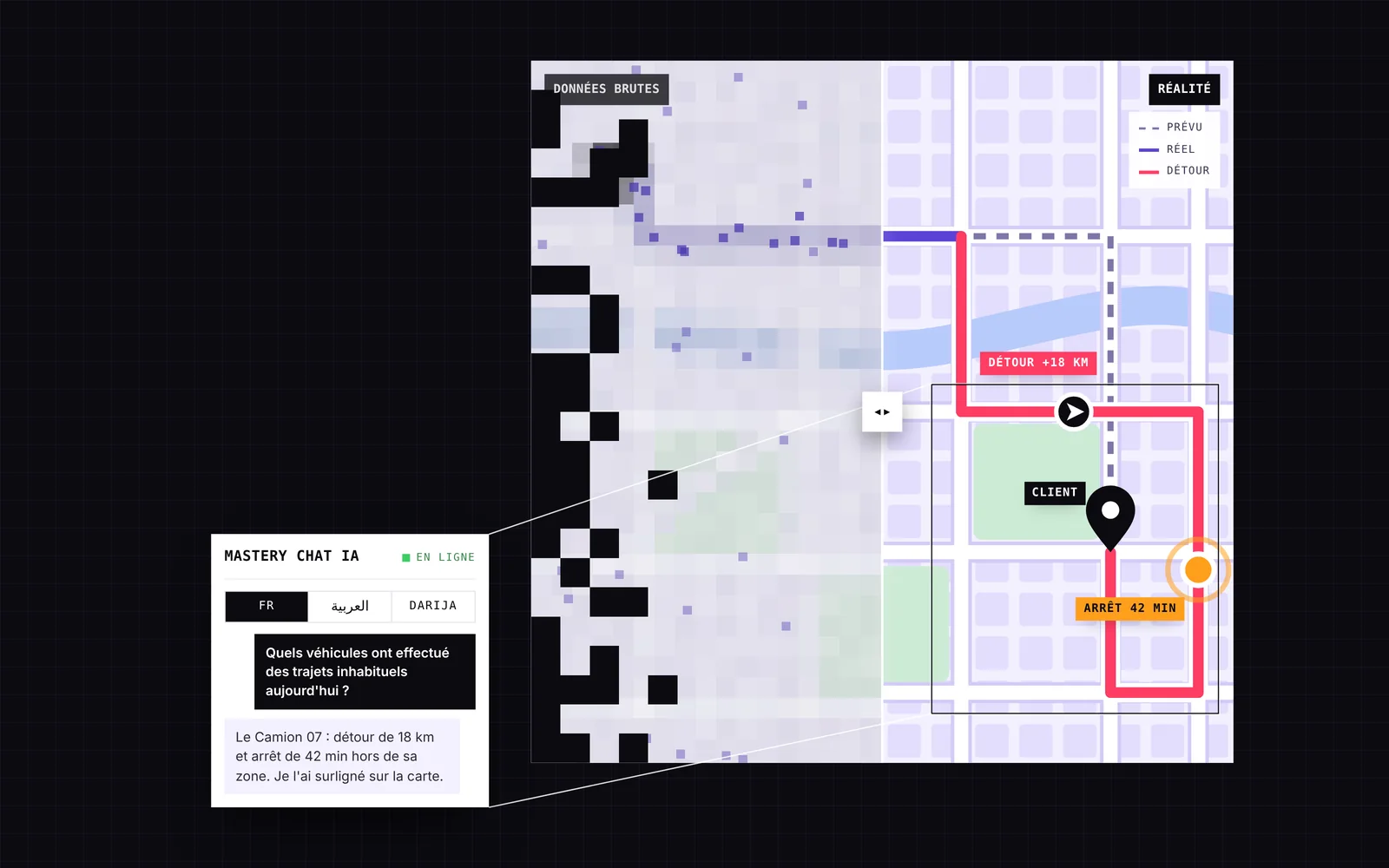
Picture a logistics manager on a Monday morning.
On the screen, dozens of vehicles on the move. Hundreds of GPS positions, fuel consumption charts, speed alerts, delivery reports and Excel spreadsheets that keep piling up.
They have all the data they need to make the right decisions.
And yet something is missing: the time to understand it.
This is exactly where artificial intelligence comes in.
Not to replace this manager. But to let them see, in a few seconds, what used to take hours of analysis.
The real problem in logistics is no longer a lack of data
For a long time, the challenge for transport companies was simple: knowing where their vehicles were.
GPS technologies brought a first revolution. Today, a company can track its fleet in real time, review trip histories, measure fuel consumption and receive alerts.
But this progress has revealed a new paradox.
We have learned to collect data much faster than we have learned to use it.
A tracking system can produce thousands of pieces of information every day. But how many of them actually lead to a decision?
How many anomalies go unnoticed because they are buried in charts?
How many litres of fuel are lost before someone notices unusual consumption?
So the question is no longer just: “Do we have the data?”
It becomes: “Are we able to understand what it is trying to tell us?”
What if you could simply ask your fleet a question?
Now picture another scenario.
Instead of opening five dashboards, exporting three Excel files and comparing several charts by hand, the logistics manager types a simple question:
“Which vehicles used an abnormal amount of fuel this week?”
Within moments, an AI assistant analyses the available data, identifies the gaps and gives an answer that is easy to understand.
They could then ask:
“Why did vehicle 125 cover more kilometres than planned?”
Or:
“Which drivers made long stops outside the authorised zones?”
And why should anyone have to master technical French or IT jargon?
The question could also be asked in Arabic or Darija:
« Chkoun men les camions li consommew gasoil kter men l'habitude had simana ? »
The stakes are huge.
Understanding data should no longer be reserved for those who know how to handle complex software.
It must become accessible to anyone who needs it to do their job.
Artificial intelligence does not know your field better than you do
There is, however, a fundamental mistake to avoid: believing that AI can understand everything and decide everything.
A machine can detect an unusual 45-minute stop. But it does not necessarily know whether the driver was waiting for authorisation, dealing with a mechanical problem or helping a customer.
It can flag excessive fuel consumption. But it does not automatically know the state of the road, the exact weight of the load or the operational circumstances.
It can suggest a shorter route. But an experienced driver will sometimes know that a theoretically optimal road is impassable for a heavy truck.
AI can detect an anomaly. Humans must understand its context.
This complementarity is what makes the real transformation.
The logistics manager brings knowledge of the field, experience and judgement.
Artificial intelligence brings the ability to analyse, summarise and detect at a scale that is hard to reach by hand.
One does not replace the other. Together, they can make better decisions.
The future of logistics will not be one more dashboard
For years, software vendors have tried to enrich their platforms.
More charts. More statistics. More indicators. More menus.
This approach made sense: making more information available.
But today, another approach is possible.
What if the best interface were simply a conversation?
An interface in which an operations director could ask:
“Give me today's review of my fleet. What deserves my attention?”
An interface able to present the important events, explain the anomalies detected and suggest courses of action.
The goal is not to get rid of maps, charts or reports.
They remain essential.
The goal is to stop forcing every user to become a data analyst to understand their own business.
The revolution will also be human
Artificial intelligence is often described as a technology reserved for engineers, data scientists and large companies.
But its most interesting potential may lie elsewhere.
- With the manager of a small fleet of five trucks.
- With the supervisor who has to coordinate fifty drivers.
- With the school transport manager who wants to spot a delay quickly.
- With the business owner trying to understand why fuel costs are rising.
These professionals do not necessarily need to learn Python, build SQL queries or master Business Intelligence tools.
They need answers.
Answers that are reliable, contextualised, understandable and, above all, actionable.
Artificial intelligence should not make work more complicated. It should make complexity invisible.
This also requires transparent systems, able to show which data their conclusions are based on and to recognise when information is insufficient.
Because a convincing answer is not necessarily a correct one.
At Mastery, this is the vision we want to build
Our conviction is simple: the future of fleet management does not rest only on collecting GPS data, but on our ability to turn that data into operational intelligence.
It is in this spirit that we are developing Mastery Chat IA: a conversational assistant specialised in mobility, transport and logistics.
Our ambition is not to create yet another chatbot.
We want to bring natural-language technology closer to professionals.
To make it possible for a manager to question their fleet, understand an anomaly or analyse an activity in French, Arabic or Darija, without having to dig through a multitude of reports.
And above all, to let them spend more time on what no artificial intelligence can fully replace: management, anticipation, human relationships and decision-making.
Logistics will remain human. Its intelligence will be augmented.
Tomorrow, trucks will still carry goods.
Drivers will still face the unexpected.
Logistics managers will still arbitrate, organise and decide.
But they could do so with a considerable advantage: no longer having to spend hours looking for information before they can act.
The real revolution of AI may not be replacing the people who keep logistics running.
It will be giving them back time, visibility and decision-making power.
Because the best artificial intelligence is not the one that thinks in place of humans. It is the one that helps them think better.
A reflection by Mastery — Technology, artificial intelligence and the future of logistics.