
 Staff dispatch
 Staff transport
 School transport
 Freight transport
 Construction & civil works
 Mines & quarries
 Agriculture
 Product distribution
 Cold-chain distribution
 Waste collection
 Ambulances & healthcare
 Vehicle rental
 Taxis
 Hotels & restaurants
Is your transport company run on numbers or on gut feeling?
“I know my trucks. I know my drivers. I know how my business works.” Many business owners could say this. But between knowing your business and actually measuring its performance, there can be a world of difference.
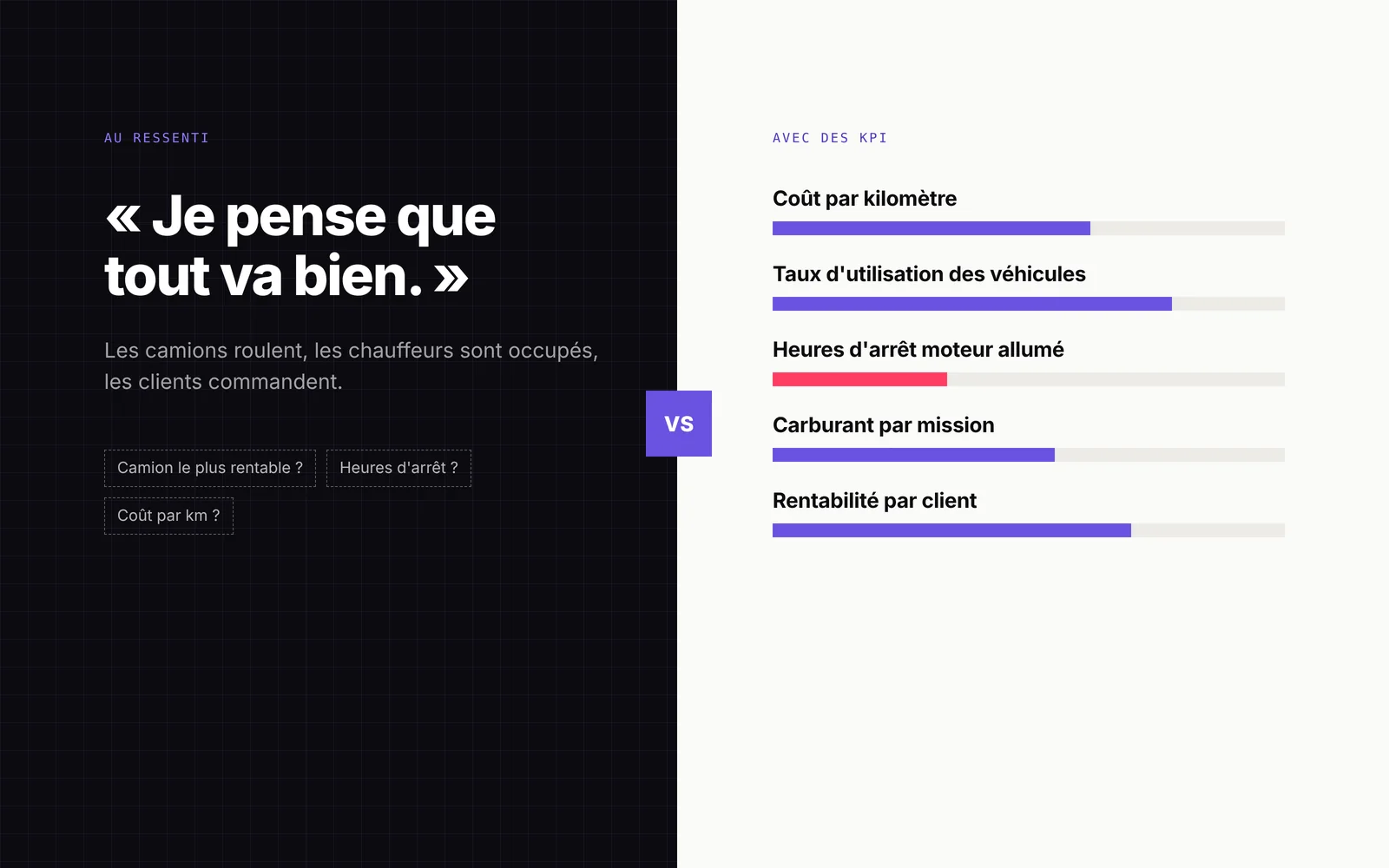
“I think everything is fine.”
Picture a conversation with the owner of a company that runs 30 trucks.
He is asked:
“How is business going?”
He answers without hesitation:
“Alhamdoulillah, fine. The trucks are working, the drivers are busy and the customers are ordering.”
Then he is asked a second question:
“Which is your most profitable truck?”
Silence.
“Which driver uses the least fuel on comparable missions?”
He thinks about it.
“How many hours a week are your trucks actually standing idle?”
He doesn't know exactly.
And yet, a few seconds earlier, he was convinced everything was fine.
He is not necessarily a bad manager. He is simply a manager who runs his company on gut feeling rather than on measurable indicators.
And he is far from the only one.
Gut feeling: the entrepreneur's first dashboard
In many SMEs, decisions are made based on experience.
An owner knows how to spot a good driver. He knows the difficult roads, the demanding customers and the periods when business slows down.
This experience is valuable.
It has been built over years, sometimes at the cost of expensive mistakes.
But it has a limit.
Our gut feeling tells us one story. The numbers may tell us a different reality.
Let's take an example.
An owner is convinced that his driver Ahmed is the best in the company.
Why?
Because Ahmed arrives early, never complains and always answers the phone.
But when his data is analysed, it turns out that he regularly drives more kilometres than other drivers on comparable missions.
Conversely, Youssef, who is more discreet, makes his deliveries with fewer kilometres and fewer unnecessary stops.
Which one really performs better?
The answer is not as simple as it looks.
And that is exactly why you need to measure before you judge.
The trap: confusing activity with performance
This is probably one of the most common mistakes in fleet management.
A truck drives all day.
So it's working.
And if it's working, it's making money.
Really?
A truck can cover 300 kilometres in a day and be less profitable than another that covers only 180.
Why?
Because you have to look at what it carries, what it bills, what it consumes and how much it costs to operate.
A very busy truck is not necessarily a profitable truck.
In the same way:
- A driver who drives a lot is not necessarily more productive.
- A growing fleet is not necessarily more profitable.
- Higher revenue does not automatically mean higher profits.
- A vehicle that rarely breaks down is not necessarily the cheapest one.
Activity gives the impression that the company is moving forward. Indicators show whether it is moving in the right direction.
KPIs: complicated words for very simple questions
You often hear about KPIs in large companies.
The term may sound technical.
Yet a KPI (Key Performance Indicator) is nothing more than a number that helps answer an important question.
For example:
“How much does each kilometre driven cost me?”
“What percentage of my vehicles is actually being used?”
“How long do my trucks stand still with the engine running?”
“Are my fuel costs rising faster than my business?”
These are not engineers' questions.
They are business owners' questions.
And to get started, you don't need fifty indicators.
A few well-chosen figures can already change the way a company is run.
A very concrete example
Imagine two transport companies, each with 20 trucks.
The first is run mainly on gut feeling.
The second regularly tracks a few indicators.
| Situation | Company A: gut feeling | Company B: with KPIs |
|---|---|---|
| Fuel | “We use too much fuel.” | Compares consumption by vehicle and by mission |
| Trips | “The drivers know the road.” | Spots unusual detours |
| Idle time | “Some trucks don't work enough.” | Measures idle hours |
| Maintenance | Reacts to breakdowns | Tracks due dates and costs |
| Profitability | “This customer is worthwhile.” | Compares revenue with the related costs |
Both companies may own the same trucks, employ competent drivers and work with the same customers.
But they don't make their decisions in the same way.
The first mainly reacts to what it sees.
The second tries to understand what is really happening.
The difference is not necessarily in the resources. It is in the quality of the decisions.
Why do business owners prefer their intuition?
There are several reasons, and they are perfectly understandable.
First, lack of time. An SME owner has to deal with daily emergencies. He doesn't necessarily have time to spend his evenings studying Excel spreadsheets.
Next, trust in his experience. When you have been running a company for fifteen or twenty years, it can be hard to accept that a chart reveals something you hadn't noticed.
There is also the complexity of the tools. Some software offers so many indicators that users no longer know which ones to look at.
Finally, there is a more human reason.
Sometimes we prefer not to measure certain things because we are afraid of discovering a reality that would force us to change.
Measuring sometimes means questioning habits.
And changing habits takes effort.
What your GPS may already know, but you don't yet
Today, many companies have GPS systems.
They can track their vehicles, review histories and receive alerts.
But these systems can also provide useful information to measure operational performance.
For example, kilometres driven, trip duration, long stops or vehicle usage time.
With the right sensors, other information can be available, particularly on fuel.
But GPS cannot measure everything on its own.
To know the real profitability of a truck, you also need to take into account invoices, maintenance, salaries and other costs.
The real challenge is therefore to bring the available information together.
Because an isolated piece of data is just a number. Data put in context becomes information you can use to decide.
What if artificial intelligence made KPIs accessible to everyone?
Imagine a manager no longer having to look for the right indicators himself.
Instead of opening several reports, he could simply ask:
“Is my fleet performing better this month than last month?”
Or:
“Which five vehicles deserve my attention?”
Or, in Darija:
« Wach les camions dyali khddamin mzyan had chhar ? »
An intelligent assistant could analyse the available data, compare periods and explain the main variations.
But one condition is essential: its answers must be based on verifiable figures.
It must not invent an explanation when information is missing.
So artificial intelligence replaces neither KPIs nor the manager's judgement.
It can simply make using them much more natural.
At Mastery, we believe in logistics that can be understood
At Mastery, we are convinced that a GPS system should not only answer the question:
“Where are my vehicles?”
It should also help answer a far more important question:
“Are my vehicles working efficiently?”
This conviction guides our vision of data analysis and the development of Mastery Chat IA.
Our ambition is to allow logistics managers and business owners to talk with their data, understand their indicators and identify more quickly the situations that need their attention.
In French, Arabic or Darija.
Because making a good decision shouldn't require becoming a statistics expert.
And because technology only has value when it genuinely helps companies work better.
The best boss is not the one who knows every number
There is a difference between being surrounded by data and knowing which decisions to make.
A manager doesn't need to know every kilometre driven by every vehicle.
He doesn't need to look at fifty charts every morning.
He needs to know the few indicators that can influence his company's performance.
And above all, he must know when to act.
Intuition will always matter.
It helps to understand people, situations and realities on the ground that data doesn't always show.
But it becomes much more powerful when it is checked against the facts.
Intuition can help you start a business. Numbers can help you run it better.
So the next time a business owner tells you:
“I know my trucks perfectly.”
Ask him just one question:
“Which one actually makes you the most money?”
His answer will probably tell you a lot about how his company is run.
Mastery — Because logistics deserves better than guesswork.